
Where the River Pauses: The Paintings of Nilesh Bharti
In the paintings of Mr. Nilesh Bharti, the river does not behave the way rivers are usually expected to. It does not rush, it does not insist on direction, and it does not attempt to carry a narrative forward. Instead, it lingers. It pauses, as if aware of being observed, as if time itself has loosened around it. This pause does not feel like stillness imposed from outside, but like a natural state the river has settled into. Here, the river is not an event. It is a condition.
Standing before these works, what becomes immediately apparent is not architecture, boats, or human figures, but air. Mist, moisture, and silence surround every form, softening edges and dissolving certainty. Shapes appear to emerge from this atmosphere only to retreat back into it. Bharti’s paintings do not attempt to fix a place on the map. They construct an inner geography, shaped as much by memory and feeling as by observation. Reality is present, but it is gently tempered.
There is a consistent refusal of spectacle across this body of work. Nothing seeks immediate attention. There are no dramatic contrasts meant to arrest the eye, no narrative gestures designed to hold it captive. These paintings ask for time. They reward those willing to slow down and remain with them.

This quiet presence is built largely through a disciplined approach to tone. Color remains secondary to value. Bharti works within a restrained tonal range, relying on carefully modulated mid tones and deliberately avoiding extremes. Whites are never harsh or absolute. They appear veiled, softened by mist. Darker values are equally restrained, never allowed to dominate the surface. Depth is created not through sharp contrast, but through a gradual fading of clarity. Space recedes without drama, and the eye moves into the painting almost without realizing it.
This tonal restraint lends the work its sense of calm. The viewer does not confront these images head-on. Instead, one drifts into them, carried by subtle shifts rather than bold declarations. Distance here is emotional as much as spatial, achieved through suggestion rather than emphasis.
This quiet presence is built largely through a disciplined approach to tone. Color remains secondary to value. Bharti works within a restrained tonal range, relying on carefully modulated mid tones and deliberately avoiding extremes. Whites are never harsh or absolute. They appear veiled, softened by mist. Darker values are equally restrained, never allowed to dominate the surface. Depth is created not through sharp contrast, but through a gradual fading of clarity. Space recedes without drama, and the eye moves into the painting almost without realizing it.This tonal restraint lends the work its sense of calm. The viewer does not confront these images head on.

Instead, one drifts into them, carried by subtle shifts rather than bold declarations. Distance here is emotional as much as spatial, achieved through suggestion rather than emphasis.
An equally important aspect of this work lies in Bharti’s treatment of the acrylic medium. Acrylic is often associated with opacity, speed, and surface control. Bharti resists these tendencies. Through careful dilution, patient layering, and controlled application, he draws from acrylic a sensitivity more commonly associated with watercolor. Translucency replaces heaviness. Edges remain softened, transitions fluid, and surfaces retain a sense of air rather than weight.
This approach is not merely technical. It reflects a clear conceptual choice. The medium never asserts itself. It remains in service of the mood. By pushing acrylic toward quietness and restraint, Bharti demonstrates a deep understanding of the material, not only of what it typically does, but of what it can be persuaded to do.
Color is used with similar economy. The palette is largely composed of cool greys, blue greys, and muted neutrals. Against this subdued ground, occasional accents of saffron or vermilion appear. These moments often coincide with ritual elements, architectural details, or fleeting human presence.
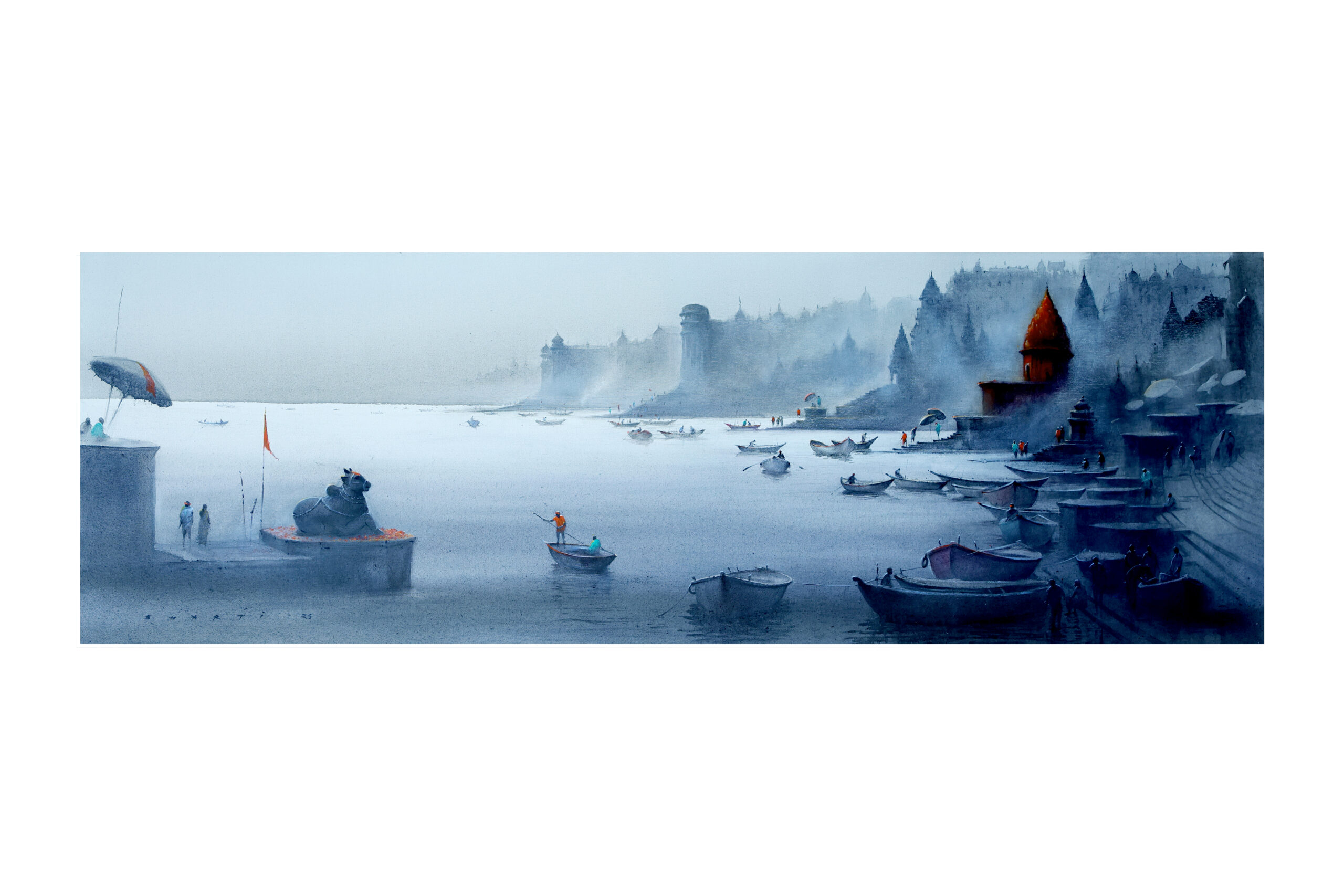
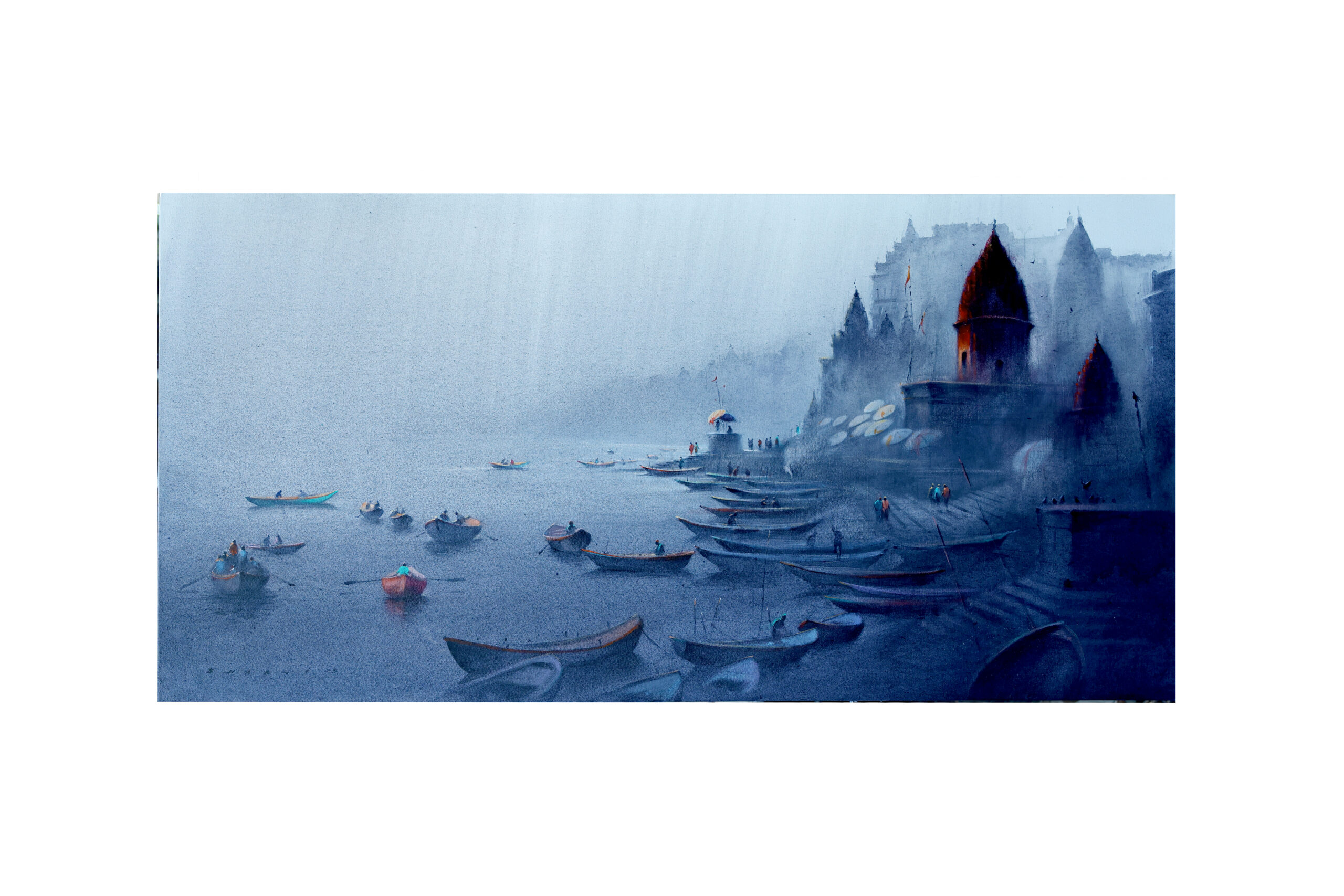
They are never decorative. Instead, they function as subtle anchors within the composition, introducing a quiet spiritual rhythm. Their restraint gives them significance. Color here does not seek attention. It carries meaning quietly.The surfaces of these paintings reveal a patient acceptance of process. Washes are layered slowly and deliberately.
One of the most telling aspects of Bharti’s practice is his relationship with detail. In a few paintings, elements such as a cycle or an elephant are rendered with noticeable clarity and precision. These passages are confident and carefully observed. They make it clear that the artist possesses the ability to sustain detailed rendering when he chooses to do so.
What becomes significant, however, is how rarely such detail is allowed to dominate. Even where it appears, it remains controlled, never disrupting the larger atmospheric balance of the work. Across most of the series, detail is consciously withheld. This restraint does not suggest limitation. It suggests awareness. Bharti appears to understand that excessive clarity can erode silence, and that too much description can flatten experience. Detail, in his work, is a choice rather than a habit.
Despite their apparent looseness, these compositions are structurally assured. Broad horizontal stretches of water anchor the images, counterbalanced by vertical architectural forms that provide stability. Negative space remains active and breathing, never empty. Foregrounds are understated, mid grounds carry faint narrative hints, and backgrounds dissolve into near abstraction. Human figures are small and anonymous, present only to establish scale and the passage of time.
This compositional language repeats across the series with subtle variation, creating continuity without monotony. The effect is cumulative rather than episodic, closer to a sustained meditation than a sequence of individual statements.
Emotionally, these paintings inhabit a contemplative register. They are not melancholic. The silence they offer is not emptiness, but awareness. They recall moments that exist between events, after rain, before prayer, at first light, between thoughts. Time feels suspended, but not lifeless. There is no urgency, no climax, no demand for resolution.
Perhaps the most compelling quality of this body of work is its discipline of restraint. Bharti consistently resists the temptation to intensify, whether through contrast, color, or narrative detail. Meaning emerges through withholding. This restraint suggests not experimentation, but arrival. These paintings are not searching for an identity. They appear settled within one.
In the end, Mr. Nilesh Bharti’s paintings invite the viewer into a space where architecture dissolves into breath, water becomes memory, and devotion exists without spectacle. They do not ask for attention. They ask for patience. They do not reward scrutiny so much as they reward stillness. And in that stillness, the river begins, quietly, to speak.